Sunday, 25 February 2018

A Starry Shetland Night

Although we didn't see an Aurora we did get some clear skies which revealed a multitude of stars


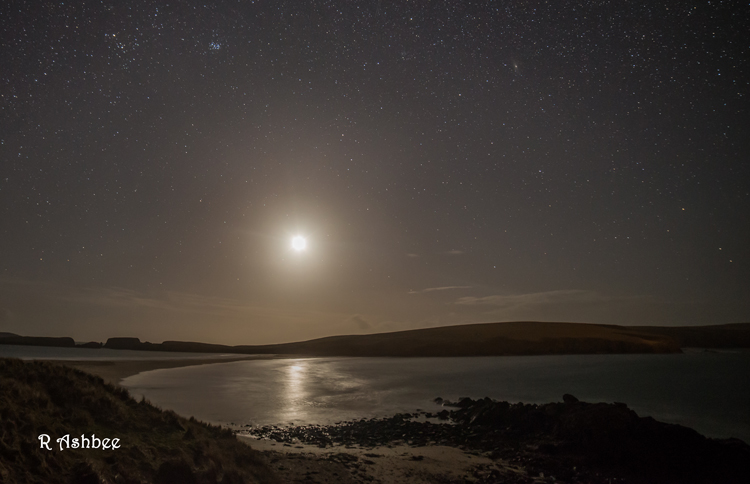
The Moon provided some nice light for the landscape, although some people prefer no moon when photographing stars I prefer about 30-40% full


The Moon was surrounded by a halo which added a bit more drama to the scene. St Ninian's always provides a good night time / daytime landscape


Light pollution is getting to be a problem everywhere, even barns(above) have powerful lighting which tends to stay on all night, wish they would at least have them on a sensor but I expect the wind would trigger them off on a regular basis


I love moonshine and the position of the moon just gave enough light to bring out the tombolo. Even shooting at ISO2000 f/2.8 15 seconds not too much noise is showing on the Nikon D610


The Milky Way was showing to the north west, above Ireland (yes we have one in Shetland)


Although it was very cold and windy I was pleased with the photos, no one else came down so I had the place to myself. With the Aurora getting less frequent due to the Solar minimum we will have to be content with looking at the stars, something I always enjoy doing. It never ceases to amaze me that you can photograph something that are thousands/ Millions of miles away and that some star have long gone.

Don't forget to join us on facebook at Shetland Aurora Hunter- just send me a request to join
Saturday, 3 February 2018

Red Sun Blue Moon

If you look back in the recent blogs I am sure you will find me mentioning that we are heading into a solar minimum. When this occurs we have less opportunity to see the Aurora. The first photo was taken at the beginning of February, the second last year. In January 2018 we had 17 days when no sunspots were visible(50%), last year there was 104 spotless days (28%)


If you look at certain newspapers some suggest that we are entering a mini ice age and back in the 1600/1700's there was a period of 70 years without sunspots and this resulted in the River Thames freezing with mini icebergs  seen.


While we will see less Coronal Mass ejections as a result of less sunspots exploding, but there will still be splits in the sun core so the Solar wind which sparks off the Aurora will still occur. This cycle is over an 11 year period


The other notable even of January 2018 was the second Super moon in the month and this is called a Blue Moon. The last time that happened was 150 years ago on the 31 March 1866. A Super moon is 14% bigger and 30% brighter and this certainly was the case but only showed for about 5 mins before the cloud came in

In some parts of the world but not in the UK there was also a Lunar Eclipse or a Blood Moon as the moon turns Red


So if you are around in 2034 the moon will be even closer to earth when it can be seen at 221, 485 miles away.

Want to see more Aurora photos, then join us on Facebook  at Shetland Aurora Hunter- just send me a request to join

Tuesday, 23 January 2018

Shetland Big Skies

Shetland has many attractions and one of these for me at least are the clouds. At this time of year the cloud formations are fantastic

These next 9 photos are down at Grutness looking east and this cloud looks like a giant iceberg


Looking west the clouds became even more spectacular and a short trip down to Jarlshof gave some good photo opportunities


Jarlshof

                                           Incredible clouds looking south to Sumburgh head


                                                 It was worth waiting 1/2 hour until the clouds collided


Hopefully more Aurora photos soon with the conditions underfoot a lot better after heavy rain

Wednesday, 10 January 2018

Moon Photography

The Moon is the most obvious target for astrophotographers, being the brightest and biggest object in our night sky

At its closest distance it is a mere 225, 700 miles away and at 252,000 at its furthest. Its great to capture the moon in its various phases. The photo above is around 3/4 full and shows off its craters to great effect


The one above photographed with a Nikon D7100 with a 800mm lens and the internal tele-converter giving a magnification of 1500mm as it has a cropped sensor


You can have the best equipment but if the atmospherics are unstable you will not get a sharp photo. This doesn't mean if it is still where you stand we are taking many 100's of miles up

                                      A typical photo with a 500m lens on a crop sensor camera


We have had a supermoon recently and people seem to get carried away with this, after all its only about 16% bigger. It does have a big effect on the tides and in Shetland it was very noticeable


Finally got an opportunity to capture a halo around the moon, this one was present for over an hour until the clouds moved in


For more information and photos why not join us on Facebook at Shetland Aurora Hunter - just send a request to join.