Friday, 27 September 2013

Meteorites

With the nights drawing in it is a great time to be out looking for meteorites. At certain times of year you may be lucky to see some , especially after midnight when they are at the largest fall rate.

The Draconids should be visible best on the 8/9 October 2013 , with a possible 100 meteorites visible throughout the night. The moon will be 16% illuminated in the region of Scorpius on the evening of the 8 October.

The Taurdis offers a good chance of seeing some , with the new moon on the 3 November it should be ideal viewing conditions with the highest rate again around mid night. often these meteorites are very slow moving compared to the rest of the year.

The Leonids will not be very good this year, as it coincides with the full moon, on the 17-18 November.These are fast bright meteorites with fine tails, associated with comet Temple- Tuttle

One of the best and highest rates of meteorites comes in December is the Geminids on the 7 - 14 December with over 100 per hour reduced to 70 per hour a few days either side. Although it can be very cold, often the skies can be clear giving a good chance to see and photograph this event. Unfortunately this year the moon will be a big problem being 89% illuminated.These are fast and bright with small trails

The Ursid shower will occur between the 22-23 December and with no Moon to talk about ,it may give the best chance for the later end of the year, again the best activity will be after mid night. Much will depend on cloud cover as ever.

Meteorites are caused by streams of debris entering the earth's atmosphere at great speed . Because meteorites travel in parallel paths they will seem to radiate away from a single point in the sky. Most are very, no bigger than a gain of sand, so cause no problems. A meteorite shower is the interaction from a planet such as earth and the debris from a comet. The debris from the comet is caused by water vapor drag, so each time a comet orbits the sun it will shed debris as ice vaporizes .

Meteorite showers are named after the constellations from which they occur. Good hunting!

Sunday, 22 September 2013

Software - astrophotography

Adobe have just announced that Photoshop CS6 is the last one where you will be able to buy the software, currently around £650. They intend to have a monthly subscription of $20. Photoshop is used by many to get the best out of their astrophotography photos.

Registax 6 is a FREE software to merge and alignment of your photos

Avistacks similar to above and includes movie and image stacking. - Freeware

Stellarium is another FREE piece of software and a must have, it is regularly updated. download link here
http://www.stellarium.org/ This is an open source planetarium showing realistic sky in 3D at real time, set from your home location

If you have a tablet why not download one of the following

1. Google astronomy sky pro free version
2. Mobile observatory (update due soon)
3. SKYORB runs on widows 8 Free version

Saturday, 7 September 2013

Sunset

Everyone loves a sunset and Shetland sunsets can rival any in the world but do they get the appreciation they deserve? In some areas of America and in Ibiza people often gather on a pier to watch the sun going down and then give a round of applause. This should happen in Shetland !

http://www.youtube.com/watch?v=7XUPyXYtFjg  (Ibiza applause for a sunset)

People capture superb sunsets and then share them on places like face book and its great to see them and for many see what they have missed. It may be that you cannot spare the time or it may be cloudy in your part of Shetland but the weather can change suddenly and give you a window of opportunity.

Every sunset is different, it is simply the sun going down in the western sky. In astronomy it is when the sun disc finally disappears below the horizon . North of the Artic circle and south of the Antarctic circle at least one day a year has no sunsets or sunrises.
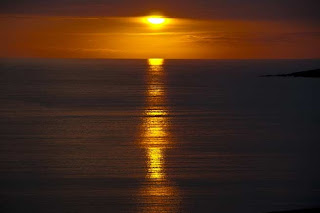
Regarding the colour of each sunset, its all about the rays of light from the sun which are scattered by airborn particles / molecules , changing the colour that the observer sees. Greens and blues,  having a shorter wavelength, are scattered more widely and are therefore not seen in the beam of light. At Sunrise and sunset when the sun is lower it has to travel further through the atmosphere which removes the blues and greens, leaving the longer wavelength colours , Orange and Red hues the more prominent. The remaining reddened light is then scattered by cloud droplets to lighten the horizon Orange and Red. Sunsets are generally more brilliant than sunrises as more air particles develop throughout the day than first thing in a morning.
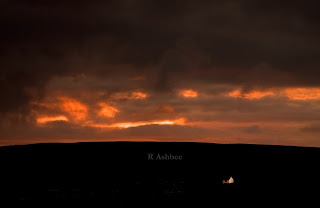
Ash from volcanoes tend to mute the sunset and sunrise colours , while volcanic ejecta that instead are thrown high up into the stratosphere can enhance any sunset or sunrise, these are called afterglows.The high altitude clouds tend to reflect the reddened sunlight down to the surface of the earth.

Some people believe in the sayings ` Red sky at night sailors delight, red sky in the morning sailors warning'. There is no doubting that people stand in awe when watching a sunset, the colour, the expectation, we feel something - What does a sunset mean to you ?

With ever changing colours it is set to inspire not just me with my camera but many more, along with artists, poets, writers, and those that just want to watch.

One of my favourite poems about sunsets

I wonder why when you say goodbye
beautiful colours paint the sky.
Shades of orange, yellow and pink too.
all come out because of you.
And though i hate to see you go,
i really do enjoy the show.
I've seen you leave so many times
and still it's a favourite sight of mine.
There'll be no sadness, be no sorrow
because my sun, you'll come out tomorrow.
I won't feel hurt, i'll feel no pain
because on your way down, your colors will reign.


and just two verses from this great poem:

Twenty-nine thousand four hundred seven sunsets
With one same sun on the one same sea.

At last, in these final days, each sunset is anticipated, craved
Regardless the mood of the sea, it will receive the sun.
No matter the face of the sky, it will let go the same.
The sun itself, always churning, always burning,
Swells with new brilliance, new radiance and splendor
Each time it approaches the sea,
Then morphs into a molten pool on the sea's surface
Before plunging from view-
Never more a sunset lost
Twenty- nine thousand four hundred seven sunsets
With one same sun on the one same sea
Then on glorious day, 
The day of my twenty-nine thousand four hundred and sixth sunset,
And I sat at my usual place along the shore,
Saw the sun rise out of the sea from where it had just set !
The sun rose back up into the sky, and
In the very next moment on the very same day, it set again.
I experienced my twenty-nine thousand four hundred and seventh sunset,
The second one in one day,
Oh glorious day !
A sunset gained.

So we don't need to join together to give applause to a Shetland sunset, but if you are the one stood on the west coast and then start to clap another Shetland sunset, then you are joining with many others that rejoice at this beautiful sight. So for now share these photos of Shetland sunsets, but make an effort to get out and find your own spot to admire the sun going down


Friday, 30 August 2013

Telescope or not

You can see alot with your own eyes once they have become accustom to the dark, but with a binoculars you can see more detail in the moon and the star fields are more apparent. With a telescope you can see detail on the planets. The first time I looked through a telescope was about 15 years ago when my brother in law bought a cheap telescope which had a flimsy tripod. From inside we managed to pick out Saturn and the image still remains with me today.

Move on another 15 years and this time i had chance to look through several telescope at the Sheffield Astronomers open night up in the Mayfield valley . What a difference, these had solid tripods and were guided, and with a choice of anything from a 6 inch to a 12 inch scope you could see the difference in quality as we viewed Jupiter and its moons.

Talking to the people that owned the telescopes it became clear that they only managed to use them around 12 times during the year, either due to other commitments or due to poor weather. That's the problem with Britain , - the weather. I know from trying to get out to photograph the night skies that it was over 3 months before viewing conditions were right and when I could spare the time over this last winter. On a couple of occasions i set off as the weather forecast said it would be clear only to find low cloud, or on one occasion fog. Unlike Australia where it seems that you could get out at least once or twice a week, for an all night session, it seems that time is very limited here.


Also when it is clear it might be too windy to keep the telescope steady, definitely a problem in Shetland, so for now at least I have decided against getting a scope which will give me more time to research the area. Many people I have spoken to have rushed in and found later that their choice of equipment was wrong. Its time to save a little more and get better equipment, especially as I would want to take photos through the scope.

We see many images today taken with then Hubble telescope and imagine that we can see this sort of quality from where we stand. We can take photos of reasonable quality but not the detail that the Hubble can bring. Even without telescope it is possible to photograph the night sky and this is what I aim to do over the coming months. Shetland has alot of very dark nights over a longer period of time than here in Sheffield, so as soon as we move to Shetland we can get started using our normal photography equipment.

I asked on Shetlink whether anyone in Shetland had a telescope.It was interesting that only one person responded saying he had a telescope (well 3 telescopes in fact). I am sure there are more !!

One thing you can do is to experience the night sky yourself by just looking up and being amazed at what can be seen throughout the year

It is worth keeping an eye on this website for the latest news
http://www.astronomy.shetland.co.uk/ and is full of hints for better observation


Friday, 23 August 2013

Moon

Being the closest planet to us the moon looks very impressive through binoculars and even better through a telescope. The wide field of view through binoculars is perhaps best and you can easily pick out craters. While the moon is full it makes looking for the fainter Nebula's difficult as it is really another form of light pollution.

Some people believe that no one has landed on the moon, but for me watching the moon landing back on the 20 July 1969 while at school started an interest in astronomy that still drives me on today.

The moons surface is interesting, on the near side areas looking like seas can be seen with the naked eye. These areas are in fact large lakes of solidified basaltic lava, these cover 31 % of the surface on the near side of the Moon. In addition several large extinct volcanoes can be seen, these are thought to have erupted about 3.5 Million years ago.The lighter coloured areas are called terrae, or highlands. The Moon has a large number of craters where asteroids and comets have collided. These are round 300,00 craters over 1 km in size on the earth side.

On the far side of the Moon, only seen from space by a few astronauts, there is a complete lack of lava pools.

The moon rotates about its axis at nearly the time as it takes to orbit the earth, therefore showing nearly always the same face of the moon. The distance from the earth varies between 356, 400 - 406,700 km. When it is the closest to the earth, this is know as a super moon, being 14% larger than when at its further limit and 30% brighter.


The phases of the moon can be seen here

Tuesday, 13 August 2013

Rain

We all know that we need rain but when it comes its depressing, often lasting many hours as it has recently in Shetland.

But just think , the photo below shows one drop of water which i managed to photograph and as it bounces back off the water surface, due tension on the water surface it has become diamond shaped. So think of this - when it rains you are getting showered with diamonds !!!!!!!!!!!!!!!
                                                                               Showers of diamond rain drops

We often refer to the rain as it is raining buckets or like cats and dogs, but this photo I am sure is it is raining in sheets . Looking over towards Sandwick, I was in the dry area watching the rain spread across. How many time does this happen, I always remember as a child standing on one side of the pavement in the sun , while people over the other side of the road were running to take shelter.
                                                                                  Sheets of rain in Sandwick

Rain droplets range in size from 0.9- 9 millimetres which tend to break up as they drop. Small drops are call cloud droplets and there shape is spherical , as the droplet increases size it become more oblate with the largest part facing the wind stream. Large droplets become increasingly flattened at the base, very large one look like parachutes.The largest rain droplets recorded on earth occurred in Brazil in 2004 when the measured 10 millimetres in diameter.
                                               Very rarely do we see a few raindrops, they usually come in their millions
                                                                                     Kingfisher caught in a rain drop

Intensity and duration in rainfall are usually inversely related ie: heavy intense rainfall is usually short lived, but short duration and intensity are long lived. When the thunder clouds form , these  are called -cumulonimbus.
              Ireland on the west side of the mainland

In  Shetland the average rainfall is 1003mm (39.5 inches), lower than many western parts of Britain and less than a quarter of the rainfall experienced in Fort William. Almost 3/4 of the annual rainfall comes in winter with April - September the drier months


Our friend Maurice Smith calculated the following

Just been doin a quick calculation. Wikipedia quotes surface area of Shetland as 1,466 square km. I reckon an inch of rainfall would put down about 36,650,000 tonnes of water on da Auld Rock. Amazin what raincloods will hadd up till dey get weary!


On Titan, Saturn's largest moon . infrequent methane rain is thought to carve the moon's surface channels

Sunday, 4 August 2013

Light Pollution

Everyone knows that the clearest views of the night sky can be found in the countryside well away from the city lights. The glow- light pollution- is a problem for astro-photographers and astronomers alike because light cast upwards from streetlights, billboards, shops reduce the contrast between the dark spaces above.

The darker the sky the faintest object become clearer, even to the naked eye. But even in our light polluted cities the larger planets can be picked out such as the Moon, Jupiter, Saturn and Mars. The Moon even becomes a problem as it very bright when it is a full Moon, when moonlight enters our sky is gives a pale blue light that washes away all the faintest objects, so it is better to observe before the moon rises or better still when it is during a new Moon.
                                                                          Full Moon photographed from Levenswick

Some councils , including Sheffield are becoming increasingly aware  of the problem with light pollution and installing better `white lighting' pointing downward which minimises the amount of light spilling upward. Only one tenth of the UK has dark skies (CPRE) and you have to go back to the 1950's to when most people could see the Milky Way. As it stands the UK has no national law in place to stop light pollution, unlike the Czech republic which passed a law in 2002, this was quickly followed by Slovenia . Dark Sky legislation is in force in several regions of Italy and the US.

Just outside Sheffield , at the Surprise view in Derbyshire this has been classified as a Dark Sky Discovery site. This means that it is away from the worst of the light pollution, provide a good skyline and have good public access. Analysis of light pollution in Derbyshire between 2004-2009 found that areas of the National Park unaffected by Light Pollution dropped from 9% to 3%
                                                                                       Night time in Lerwick

 From the CPRE map you can see that Shetland is a Dark Sky area , the only light pollution of note coming from the Oil Rigs etc in the North Sea of the East coast. Keeping away from Lerwick, Scalloway, Sandwick and Voe will increase your chances of a superb nights viewing


Air turbulence is another problem when trying to photograph or to view at high magnification through a telescope.You all know the effect heat haze has, if the sun has been beating down on a concrete yard it will hold the heat the release it slowly as night comes along. But the air above is heated an creates a whirlpool situation. That's why it is better to pick a shaded spot to observe from. Also as heat rises from a house it is best to avoid viewing from inside. Likewise it is better to bring the equipment outside and allowed to cool down before starting o observe or photograph.

The Antoniedi scale can be used to classify viewing conditions fore the Moon and other planets. One is the best, being perfect without quiver, while 5 is the worst with serve undulations that don't allow features to be made out clearly

A cloudy sky will make it impossible to view or take photos, but a hazy sky heavy with water droplets  will also make it difficult. A halo around the Moon indicates that atmospheric conditions are poor.