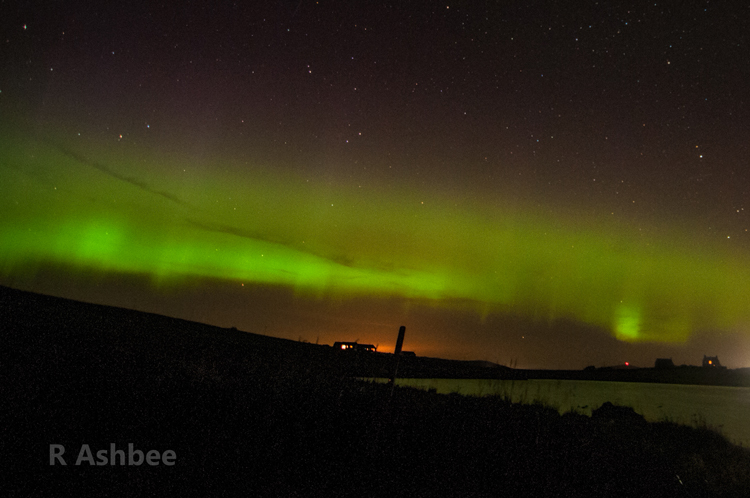
Finally a few clear night, which didn't coincide with other events. The first was out west following an excellent night at the accordion & fiddle festival at Skeld. The sky was full of stars and the aurora prediction was for KP5, so on the way back around midnight we stopped off at Park Hall, a venue i wanted to get to for while.
The building is now abandoned, but has all the right ingredients. It is set in ts own grounds, looks good in silhouette facing north with no light pollution. Although it was a bit breezy i set up the Nikon D7000 with the Tokina at 11mm with a faint trace of the aurora.
I picked this particular night as I needed the car headlight to hit the building and with a steady stream of cars heading back from the festival it provided a good opportunity as normally the road is very quiet normally.
While the stars looked good the aurora failed to get brighter, later i found out the it was the best around 8 pm. I also lit the building with a powerful LED which shows just how blue the light is compared to a better looking light, via the headlights.
The milky way looked good as well with little light pollution the stars really stood out
Then earlier this week another alert of KP5 with the forecast of a mainly clear night. i headed over to Bigton and set up at the top of the hill overlooking St Ninians tombolo. It was completely still, very unusual in Shetland but the cloud was the main problem, the forecast completely wrong again. The aurora hidden by the cloud.
This was a good time for astrophotography as the moon was new so no light pollution.
After this I headed up Scousburgh Hill with great views north, it was just a shame about the cloud, but it did have some breaks. Again this is normally a windy place but not on this night . I did include the giant bucket left after construction of some buildings which provided some foreground interest.
Wednesday, 14 October 2015
Wednesday, 30 September 2015
Sun Spots
With the long summer !! nights here in Shetland there has not been much chance for night photography.
So its all down to photographing the sun- Please use a special solar filter
Sunspots with a solar filter can be photographed when its sunny of course. Setting up on a tripod, a 500 mm lens and using a cable release is all that is needed. Don't look through the viewfinder it is very dangerous but instead use live-view which is safe. If you did view the sun with your naked eye you will feel no pain because your retina has no nerve endings, you will become blinded almost instantly. Even after a short while the lens end temperature will reach 500 degrees, so as soon as you have finished photographing move the camera away from the sun
After focusing in live view you can fire away, the sun is always a superb target. With a 500 mm zoom lens its best to go down to a 150 mm , find the sun then zoom in, the sun doesn't stay in view long but it can be easy to find. The solar filter cuts the light down so I use ISO 400 and shoot around f/8.
Sunspots add interest, these are small dark markings in the sun's photo sphere, large storms not of rain and wind but of intense magnetic activity. Because they are magnetic they always appear in pairs with opposite magnetic polarity.
The dark spots are in fact cool areas in a very hot mass. These move left to right across the suns surface (northern hemisphere) , normally lasting no more than 14 days. Some don't make it across the whole surface.
Every 11 years sunspots reach a peak and within a year 100's can be seen. But every 5.5 years after the peak very few or none will be visible. The peak activity for sunspots also occurs with other activity, which include mass ejections, called corona.
Some people also have concluded that in periods of little activity, very cold weather occurs on earth. Like wise in years of very active sunspots the sun temperature will rise could this be Global warming ??. The last peak activity was back in 2011, so you would expect less sunspots from mid 2017 on.
The other good thing is in periods of high activity there is a greater chance to see the Aurora (Northern Lights) .
Auroras can be superb colours but when they are around KP3-4 they look dark on the horizon and sometimes you have to use your camera to tell they are actually showing as the eye cannot detect low activity.
So its all down to photographing the sun- Please use a special solar filter
Sunspots with a solar filter can be photographed when its sunny of course. Setting up on a tripod, a 500 mm lens and using a cable release is all that is needed. Don't look through the viewfinder it is very dangerous but instead use live-view which is safe. If you did view the sun with your naked eye you will feel no pain because your retina has no nerve endings, you will become blinded almost instantly. Even after a short while the lens end temperature will reach 500 degrees, so as soon as you have finished photographing move the camera away from the sun
After focusing in live view you can fire away, the sun is always a superb target. With a 500 mm zoom lens its best to go down to a 150 mm , find the sun then zoom in, the sun doesn't stay in view long but it can be easy to find. The solar filter cuts the light down so I use ISO 400 and shoot around f/8.
Sunspots add interest, these are small dark markings in the sun's photo sphere, large storms not of rain and wind but of intense magnetic activity. Because they are magnetic they always appear in pairs with opposite magnetic polarity.
The dark spots are in fact cool areas in a very hot mass. These move left to right across the suns surface (northern hemisphere) , normally lasting no more than 14 days. Some don't make it across the whole surface.
Every 11 years sunspots reach a peak and within a year 100's can be seen. But every 5.5 years after the peak very few or none will be visible. The peak activity for sunspots also occurs with other activity, which include mass ejections, called corona.
Some people also have concluded that in periods of little activity, very cold weather occurs on earth. Like wise in years of very active sunspots the sun temperature will rise could this be Global warming ??. The last peak activity was back in 2011, so you would expect less sunspots from mid 2017 on.
The other good thing is in periods of high activity there is a greater chance to see the Aurora (Northern Lights) .
Auroras can be superb colours but when they are around KP3-4 they look dark on the horizon and sometimes you have to use your camera to tell they are actually showing as the eye cannot detect low activity.
Saturday, 12 September 2015
Tingwall Aurora
`No colour and no brush is able to paint it;no words can describe it in all its grandeur' - Karl Weyprecht
If there is one thing people would like to see, its the aurora. These magical lights are very elusive but you can increase your chances of seeing the Northern Lights (Aurora) by living in an area that is as far north as you can go.
Shetland therefore has to be the best place, especially as a lot of auroras are dim even from Shetland, around KP4 and are therefore not normally seen further south. These last few days however have been better with KP6.5 recorded, but as luck would have it we had been out and missed it. Just as we headed on holiday a KP8 hit and people in Shetland had some amazing colours- and clear skies.
On Thursday we went up to Asta to listen to some music and looking through the window about 9pm i could see stars and a clear sky. The temptation was too strong, especially as there was no moon (Light pollution) so we decided to go up to the boat shed further up the valley.
We pulled up beside another car where two other people stood watching the sky to see whether any aurora would be visible. Both these people were German and had the spot recommended by their B&B.
The glow in the sky revealed that the aurora was present, but weak. I took a photo which showed a green glow, visible to the sensor in the camera but not to the untrained eye. They seemed quite amazed that they had been looking at the sky for over an hour but didn't realise that they had been seeing the aurora.
They left soon after and missed a stronger aurora quickly developing , along with the green glow (the normal colour) a layer of purple sat on top, curtains and pillars of light began to form and moved across the sky. It was an amazing sight, the best aurora we had seen since moving to Shetland. You cannot witness such a beautiful phenomenon without the sense of awe.
It just confirmed to us how quickly the aurora can develop and then recede, easy to miss especially if you have to travel a distance
The location was reasonable, a dark site but with a steady stream of cars coming down the valley. The red glow coming down from the wind turbines looked spooky. The International space station and a meteor added to the scene.
When photographing the aurora you need to ensure you have a strong tripod, one that doesn't get blown about in the wind. Be prepared to change settings when the aurora starts to develop. I usually start with around ISO 800 - 1000, with 20sec exposure using a Nikon D7000, Tokina 11-16mm lens at 11mm, at f/2.8
On Friday aurora alerts kept coming through the day, no good for seeing anything in the night sky, and as darkness fell the strong winds F7 and cloudy skies did nothing to encourage me to go out
If there is one thing people would like to see, its the aurora. These magical lights are very elusive but you can increase your chances of seeing the Northern Lights (Aurora) by living in an area that is as far north as you can go.
Shetland therefore has to be the best place, especially as a lot of auroras are dim even from Shetland, around KP4 and are therefore not normally seen further south. These last few days however have been better with KP6.5 recorded, but as luck would have it we had been out and missed it. Just as we headed on holiday a KP8 hit and people in Shetland had some amazing colours- and clear skies.
On Thursday we went up to Asta to listen to some music and looking through the window about 9pm i could see stars and a clear sky. The temptation was too strong, especially as there was no moon (Light pollution) so we decided to go up to the boat shed further up the valley.
We pulled up beside another car where two other people stood watching the sky to see whether any aurora would be visible. Both these people were German and had the spot recommended by their B&B.
The glow in the sky revealed that the aurora was present, but weak. I took a photo which showed a green glow, visible to the sensor in the camera but not to the untrained eye. They seemed quite amazed that they had been looking at the sky for over an hour but didn't realise that they had been seeing the aurora.
They left soon after and missed a stronger aurora quickly developing , along with the green glow (the normal colour) a layer of purple sat on top, curtains and pillars of light began to form and moved across the sky. It was an amazing sight, the best aurora we had seen since moving to Shetland. You cannot witness such a beautiful phenomenon without the sense of awe.
It just confirmed to us how quickly the aurora can develop and then recede, easy to miss especially if you have to travel a distance
The location was reasonable, a dark site but with a steady stream of cars coming down the valley. The red glow coming down from the wind turbines looked spooky. The International space station and a meteor added to the scene.
When photographing the aurora you need to ensure you have a strong tripod, one that doesn't get blown about in the wind. Be prepared to change settings when the aurora starts to develop. I usually start with around ISO 800 - 1000, with 20sec exposure using a Nikon D7000, Tokina 11-16mm lens at 11mm, at f/2.8
On Friday aurora alerts kept coming through the day, no good for seeing anything in the night sky, and as darkness fell the strong winds F7 and cloudy skies did nothing to encourage me to go out
Sunday, 9 August 2015
Shetland Hints and Tips
What can be seen in the Shetland Night sky- well nothing at present as it is too light. Harry Rose recently gave a very interesting talk, in which he indicated that providing you are not near a light polluted area you can actually see a lot in the Shetland night sky.
He showed the benefits of using binoculars either 8x40 which has a wide view or very high powered but tripod mounted version.
With so much to see in the sky, Harry recomended being as comfortable as possible, warm clothing and a good chair, even a deck chair or perhaps laying on the ground in a sleeping bag.
A massive amount of stars can be seen in these dark skies and he provided an insight into where and when to look for key star clusters. Knowing a few star groups such as the Plough, the Pole star Cassiopeia or Orion can be a great help in locating other star clusters and even the Milky Way.
It was interesting to hear about massive distances that would be necessary to travel across certain objects such as the Orion nebula, more miles than we can comprehend. That's not all, what we are looking at is the past as light travels slowly and it might be millions of year before the light from a star arrives on earth.
Harry explained everything in terms that everyone could understand, rekindling interests that have laid dormant in people for years. He was very enthusiastic about what could be seen in Shetland skies, much more than other places in the UK that have more light pollution.
The nights are now getting darker so it wont be long until we can all get out and start photographing the night sky
He showed the benefits of using binoculars either 8x40 which has a wide view or very high powered but tripod mounted version.
With so much to see in the sky, Harry recomended being as comfortable as possible, warm clothing and a good chair, even a deck chair or perhaps laying on the ground in a sleeping bag.

A massive amount of stars can be seen in these dark skies and he provided an insight into where and when to look for key star clusters. Knowing a few star groups such as the Plough, the Pole star Cassiopeia or Orion can be a great help in locating other star clusters and even the Milky Way.
It was interesting to hear about massive distances that would be necessary to travel across certain objects such as the Orion nebula, more miles than we can comprehend. That's not all, what we are looking at is the past as light travels slowly and it might be millions of year before the light from a star arrives on earth.
Harry explained everything in terms that everyone could understand, rekindling interests that have laid dormant in people for years. He was very enthusiastic about what could be seen in Shetland skies, much more than other places in the UK that have more light pollution.
The nights are now getting darker so it wont be long until we can all get out and start photographing the night sky
Sunday, 5 July 2015
All about the universe in 55 mins
Last week I invited Mike Breimann down from Mossbank to Lerwick to give a talk on how the Universe was formed. This was aimed at some elderly folk with very little knowledge of Astronomy
Do take a look at his website at www.macastrofix.info
Sunday, 28 June 2015
Missing stars
The other night I was speaking to a friend in Sheffield who had not noticed the stars until he went camping to Galloway forest Park Scotland early in the year. He said he just stood looking up at the stars for hours he was just amazed with what he could see, but since getting back to Sheffield he has started to miss these really dark skies.
It's difficult for some people, those moving from a dark sky in Shetland to a city swamped in artificial light, they really miss the stars. Looking the other way, people don't miss something they have never seen, and this is where many thousands of people fit
I wonder what Shetland was like 75 years ago this would have been a true dark site with many areas without electricity, the stars would have been amazing, but you wouldn't want people to have been with out power. they had small lights/lamps which would have just been sufficient to light the house.
During WW2 areas had to be dark otherwise they could be bombed, people managed although some people did die as a result of being knocked down etc. People's eyes did get used to the dark and although the slogan ` eating carrots make you see better' didn't really work, it was a nice thought.
Although our eyes adjust to the dark after about 10 mins just think how better it would be if we had to do it longer, some people seem to develop a 6th sense of where things are.
We missed out on an alert of a aurora at KP 8 a few days ago this came about mid afternoon when it was too light, but a few people managed to see it after midnight down in the south of England, it looks like we will have to wait until September comes along to see another Aurora as it gets lighter and lighter
I was talking to Robbie Brookes the other day, who is lucky enough to live in Unst a very dark site, or so you would think, he still has to travel to Lamba ness above Haroldswick to ensure a completely dark sky, he has some great Aurora photos as a result.
On another occasion I was chatting to a visitor to Shetland who lived in the centre of London but couldn't drive (but who would drive in the centre of London) he cannot ever remember seeing a dark sky. His holidays are in the summer and work keeps him in London most of the time so doesn't come across dark skies. He moves from one light source to another in London, he said he is drawn to the bright lights and has never though about the dark - or what the attraction is !
Great Skies over Lerwick
Lights and brighter lights are an attraction in cities, but in Shetland they could easily cut out unnecessary light by turning half the street lights out after midnight, a lot of jetties are lit all night -whats the point. Shetland could gain a lot of tourists if it became more of a dark site then advertise this, yes we do get a lot of cloud , but winter tourism has been neglected except for up Helly Aa. In America lots of people travel many miles to get to a dark site, i am sure it could be done here
Shetland remains the best dark sky site for me, the large open spaces & large skies make watching easier, we even get still clear nights sometimes. It must be a good place for space watching as Doctor Who and Darth Vader have settled in Shetland, what better recommendation.
The Tardis near Sullom Voe
We have now turned the corner and move away from the Simmer Dim and head towards autumn we can start to think again about dark skies, in the meantime its all about cloud gazing here, no problem with the wide vistas in Shetland.
It's difficult for some people, those moving from a dark sky in Shetland to a city swamped in artificial light, they really miss the stars. Looking the other way, people don't miss something they have never seen, and this is where many thousands of people fit
I wonder what Shetland was like 75 years ago this would have been a true dark site with many areas without electricity, the stars would have been amazing, but you wouldn't want people to have been with out power. they had small lights/lamps which would have just been sufficient to light the house.
During WW2 areas had to be dark otherwise they could be bombed, people managed although some people did die as a result of being knocked down etc. People's eyes did get used to the dark and although the slogan ` eating carrots make you see better' didn't really work, it was a nice thought.
Although our eyes adjust to the dark after about 10 mins just think how better it would be if we had to do it longer, some people seem to develop a 6th sense of where things are.
We missed out on an alert of a aurora at KP 8 a few days ago this came about mid afternoon when it was too light, but a few people managed to see it after midnight down in the south of England, it looks like we will have to wait until September comes along to see another Aurora as it gets lighter and lighter
I was talking to Robbie Brookes the other day, who is lucky enough to live in Unst a very dark site, or so you would think, he still has to travel to Lamba ness above Haroldswick to ensure a completely dark sky, he has some great Aurora photos as a result.
On another occasion I was chatting to a visitor to Shetland who lived in the centre of London but couldn't drive (but who would drive in the centre of London) he cannot ever remember seeing a dark sky. His holidays are in the summer and work keeps him in London most of the time so doesn't come across dark skies. He moves from one light source to another in London, he said he is drawn to the bright lights and has never though about the dark - or what the attraction is !
Great Skies over Lerwick
Lights and brighter lights are an attraction in cities, but in Shetland they could easily cut out unnecessary light by turning half the street lights out after midnight, a lot of jetties are lit all night -whats the point. Shetland could gain a lot of tourists if it became more of a dark site then advertise this, yes we do get a lot of cloud , but winter tourism has been neglected except for up Helly Aa. In America lots of people travel many miles to get to a dark site, i am sure it could be done here
Shetland remains the best dark sky site for me, the large open spaces & large skies make watching easier, we even get still clear nights sometimes. It must be a good place for space watching as Doctor Who and Darth Vader have settled in Shetland, what better recommendation.
The Tardis near Sullom Voe
We have now turned the corner and move away from the Simmer Dim and head towards autumn we can start to think again about dark skies, in the meantime its all about cloud gazing here, no problem with the wide vistas in Shetland.
Subscribe to:
Posts (Atom)