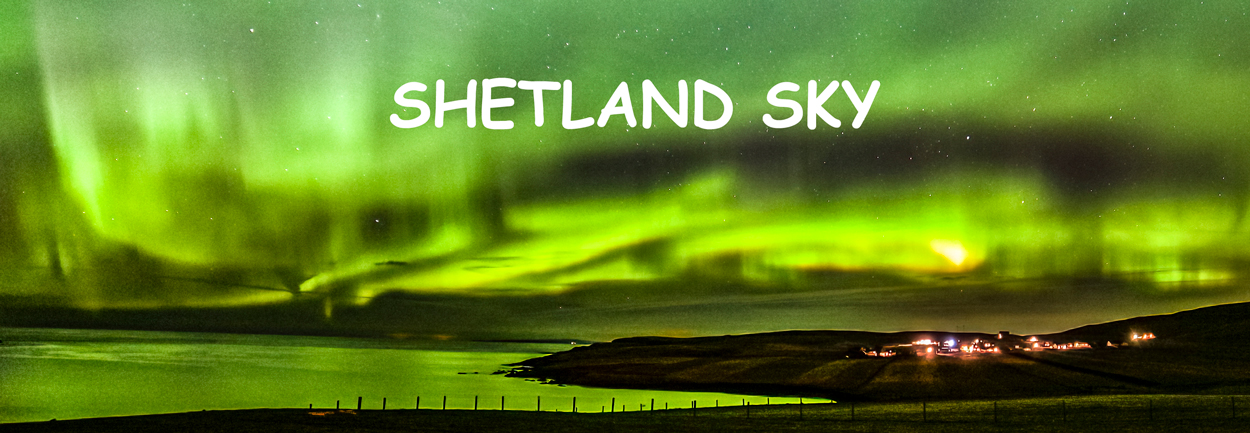
Last Sunday 18 March 2018 will go down as one of the best but most unexpected Aurora displays we have seen so far in Shetland
The forecast was for a moderate display, so on a clear wind free night we headed out over to Bigton
As soon as we arrived we could see the Aurora with our naked eye, it was very active with pillars of colour above the large dense green area
After about 10 mins I notices a band overhead and immediately recognised this as `Steve', a vary rare form of Aurora. Steve or
Strong Thermal Emission Velocity Enhancement has only recently been discovered
It appears as a distinct purple ribbons with green edges and it constantly moving across the sky. NASA indicates that is can be found at low altitudes than the normal Aurora
The European Space Agency who has been studying this, has published a detail account in the journal Science Advances (March 14). Since it was discovered it has been seen in the UK, New Zealand, Alaska, Canada and the northern United States.
According to NASA Steve can be found south and lower down the normal Aurora activity and can last anything from 20 mins up to an hour. It stretches East - West. A green colour associated with Steve is usually short lived
It is also known by some astrophotographers as a Proton Arc but in fact it is a subauroral Arc.
A Proton Arc is subvisual, diffused and broad where as this Subauroral Arc is narrow, bright and structured
It seems that it was first seen in 2015 and has been viewable about 30 times. Observations occur when there is increased Aurora activity
Steve seems to connect to different magnetic field lines closer to the equator so it is seen further south than the normal Aurora. When we saw it, it was overhead about 60 degree north originally seen as a long purple line then it split and looked like a broken line. Some think its like an elastic band which when it breaks causes a charge particles bounce back towards earth. This may have been caught below because just after it faded away
see more on Facebook at Shetland Aurora Hunter.
More Steve photos to come in the next blog