Showing posts with label amazing Shetland. Show all posts

Sunday, 13 November 2016

Moon washed aurora

At last a break in the cloud and rain free night with only a Force 3 wind. That's good for Shetland so we headed out  last night knowing that the Aurora forecast was around a KP5


                                                                                                 St Ninian's Tombolo


We arrived at a reasonably dark site, well normally until you take into account a near full moon that was brightening all the landscape. Tomorrow it will be a Super Moon (although looking at the weather for tomorrow it looks like rain so i doubt whether we will see it in Shetland

                                                                           A pillar of light, game on !


While the moon provided good detail in the landscape it was washing out any aurora that might appear in the sky, except i could just make out a pillar of light.


To show how bright it was on the night i was using ISO 500 15 seconds at F/3.2, unlike the last time we went out and I was having to use ISO 3200 together with some light painting


The pillar of colour did expand for a minute or so then faded away. This is typical aurora activity, some bursts of activity are very short while others last hours.

With several dark sites only around 15 mins away we are well placed to get there fast.


Still looking for that mind blowing aurora but i am sure it will come soon, however any aurora nights are worth seeing , hopefully getting some photos as well


Looking south from Bigton is St Ninian's tombolo, this looks good in the day and at night


Just an update, the Night Sky course i am running on 11 April 2017 for Shetland Adult Education is now full and the Intermediate Photography Course which includes a session on Astrophotography starting at the end of February 2017 is also full.

You still have time to buy a canvas for Christmas, see full details at www.amazingshetland.co.uk

Wednesday, 28 September 2016

Aurora captured

While people have been watching the aurora for many thousands of years its only recently that we have been able to capture the aurora on camera


Often without the aid of the camera we could miss a weak aurora, the camera sensor is far more sensitive than our eyes. You have to go back to 1892 to when the first aurora photograph was taken which showed some structure, this was taken by  two Germans,  Otto Beschin & Martin Brendel using a highly sensitive plate and a wet process.


Before this Robert Esther tried back in 1885 when he achieved a blurry aurora photograph with an eight and a half min exposure which blurred out the aurora and was never published. Today with advanced digital DSLR cameras we can take exposures of a few seconds which show some great detail.


Long before cameras came along people felt a strong need to capture the aurora in some way to show others, some would turn to art, others tried to describe it in words but now many people try and capture it digitally.


As i have said before its on most people's bucket list and i have spoken to a number of visitors to Shetland who have come up in winter to catch a glimpse or better still a photograph of the Merrie Dancers as it is call here.


Green is the main colour that we see but on some occasions when there is a big storm other colours are evident such as Red and Purple although the latter is less frequently seen. The Red colour is often seen at about 120 miles up with the Green colour lower at 90 miles high and Blue and Magenta at 60 miles high.


I was glad to be out Monday night as this was the only night to have clear skies all this week, the wind was not too strong either but with a major aurora at KP6 on a couple of nights later in the week I was very disappointed to find that it was total cloud cover, heavy rain and up to gale force 8 so no chance of even seeing the aurora.

The milky way was spectacular as well. with no light pollution from the moon many thousands of stars could be seen


see more photos at www.amazingshetland.co.uk

Monday, 12 September 2016

Milky Way

Until we moved to Shetland we never had a chance to see the extent of the Milky Way, this was all down to light pollution. Even if we went to our darkest spot, mid way between Sheffield and Manchester, in the Derwent Valley we would still see light pollution. Then moving to Shetland we could find darker areas, when combined with a new moon it gave us a chance to see the superb Milky Way and to photograph it.


When you consider that the Milky Way may have between 200 - 400 Billion stars it can be mind blowing.
                                               All photo from St Ninian's Isle, Shetland

When conditions are right you can see the milky area which consists of dust and gas.

While we may be able to get impressive photos from earth nothing will compare to those of Gaia which is a giant telescope launched towards the back end of 2013 and will transmit a map of the Milky Way on its Billion Pixel camera in a few days time on the 14 September 2016- so keep a look out for this.

I was pleased to capture 3 satellites in this photo 
Cosmos 332 Rocket
Cosmos 371 Rocket
Cosmos 2233 Rocket
(all within 33 seconds SSW)

The best time to see the Milky Way in the northern hemisphere is September - March, the darkest time. Unfortunately this is not the time when the brightest part is over the UK, the brighter Galactic centre is over head April - August when we are experiencing long hours of daylight, especially in Shetland with the `Simmer Dim'.


What you see with the naked eye,  is a white milky area to the southern skyline but the camera can pick up lots more detail with its sensitive sensor. You will need a tripod as the exposure, depending on whether you are using a wide angle lens with a full frame, crop sensor, bridge or compact camera can vary tremendously but can be anything up to 35 seconds

The more light that is captured the better, resulting in a more detailed photograph with less noise.

There are Dark Sky Discovery sites around the UK-
http://www.darkskydiscovery.org.uk/dark-sky-discovery-sites/map.html
A map shows where the best places are to see the Milky Way, but amazingly none are listed in Shetland.

A recent survey claims that 60% of Europeans and 80% of Americans cannot see the Milky Way due to light pollution

For more Shetland Photos see my blog www.amazingshetland.co.uk
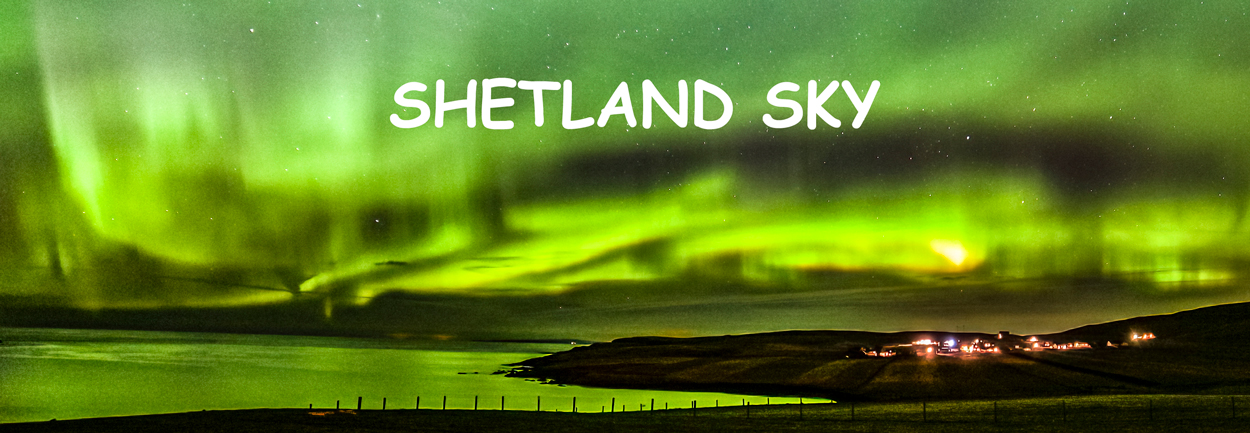
Tuesday, 6 September 2016

Better second night

Managed to get out for second night this weekend. The night promised better clearer weather than the night before, although it was windier.


The aurora forecast predicted KP4-5 for the night and checking it around 9pm it was at KP5 but decreasing and far too light to venture out


We made the decision to head west and it paid off as cloud suddenly came in on the east side. As we parked up we could see the stars and a hint of the aurora.


The glow of the aurora could be seen as a milky white area but clearly showed up on the camera, always try this the camera sensor is far more sensitive than our eyes. The photos shown here had the following settings ISO2000 F2.8 @20 seconds.


Seeing a few photos from the south east side of Shetland I am glad we travelled over to the west as cloud really did increase


Some people have said the aurora makes a sound like jingling keys, you have to be a lot nearer to a major storm to hear anything. One thing is for certain they do make a noise, listen here for the sound of the aurora on Jupiter  its amazing

https://www.youtube.com/watch?v=slE2i0O0pDY

To see more photos of Shetland include the aurora (Northern Lights) go to www.amazingshetland.co.uk