We are so fortunate in Shetland in having large skies, not restricted by buildings or trees. This allows you to see a sky full of superb clouds. The weather is always changing and as a result it brings great cloud formations, you just have to keep looking up.
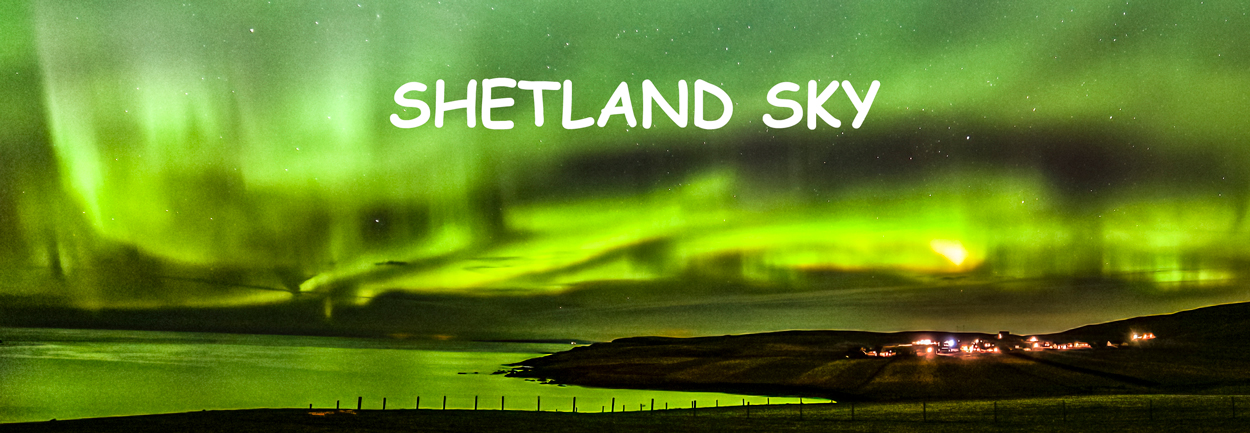
After the showers we also get many rainbows, some very strong colours. This makes up for not being able to see any Auroras at this time of year, normally it doesn't go dark until after 11 pm. They don't even turn the street lights on until 10.45 pm, this is the land of the simmer dim.
Friday, 5 June 2015
Sunday, 12 April 2015
Too Light
Continuing on from last blog this map clearly shows how much light pollution could be seen either side of Sheffield

Spring ad Summer can be frustrating times for the astrophotographer with little dark time this side of midnight. Shetland has virtually 21 hours of day light with the other 3 hours classed as simmer dim when it never gets truly dark
How dark ?
With the days getting longer and longer ,opportunities to view the night sky in Shetland become very difficult. We are moving towards Simmer Dim when its virtually light all night, you can even read outside after midnight without a light.
Looking back on this winter you notice that the nights are actually darker than when we lived in Sheffield. There is still light pollution from Cunningsburgh and then further north to Lerwick. They missed an opportunity when they failed to replace the streetlights with LED lights which give a whiter light, not the orange glow usually associated with street lights.
Darker skies mean that you can see more stars especially when the moon is not showing

Save our Stars is an initiative to get people thinking and looking at astronomy visiting darker sites not the light polluted urban sites.
The Bortle Dark - sky scale is the measurement of how dark the sky is. there are 10 sections to consider

Credit: Del Mar Fans
"http://www.delmarfans. com/educate/basics/lighting- pollution/"

I would say that I consider Sandwick in Shetland to be class 2 - 3

There are few places in Europe that will be class 1 perhaps northern Scandinavia is the best spot, but Shetland away from Lerwick Scalloway and Brae do offer far better chances of a dark sky than the mainland England.

North America and Northern Europe are poor places for light pollution

Light pollution in Shetland mostly around the central area and the oil fields out to the east.
Choosing a night which is as dark as possible will mean one with no moon. I have been surprised when talking to others about astrophotography that they think they need to light from the moon to take star photos, a natural conclusion when you think of normal day time photography.
I would highly recommend this book it really gets you thinking !

The Shetland Island council indicated in their document http://www.shetland.gov.uk/developmentplans/documents/LIGHTLEAFLETpdf.pdf (2004)
that they intend to use lights that shine down like the LED lights but seem not to have taken this into account in the Cunningsburgh area.
When the Daily Telegraph listed the best sites for star gazing in the UK they failed to list Shetland although looking at the content they seem more to value what accommodation is available locally then the actual site
We can all help in reducing light pollution, do you really need all your lights on. One of our neighbors leaves all his room lights on all night another doesn't seem to have a sensor on his outdoor light. it worth checking out this site http://www.need-less.org.uk/ the Night Sky simulator near the bottom of the page, although for some reason they don't go any further north than Fair isle
While some may say they need light for safety reasons we can easily reduce the amount we use and at the same time reduce our bills . The SIC has now started to turn some street lights off at certain times, more to reduce costs. Did you for instance turn your lights off for an hour at 20.30 pm on the last Saturday in March as part of Earth Hour ? this is a world wide event. The next time for Earth Hour is the 26 March 2016.
Looking back on this winter you notice that the nights are actually darker than when we lived in Sheffield. There is still light pollution from Cunningsburgh and then further north to Lerwick. They missed an opportunity when they failed to replace the streetlights with LED lights which give a whiter light, not the orange glow usually associated with street lights.
Darker skies mean that you can see more stars especially when the moon is not showing
Save our Stars is an initiative to get people thinking and looking at astronomy visiting darker sites not the light polluted urban sites.
The Bortle Dark - sky scale is the measurement of how dark the sky is. there are 10 sections to consider
Credit: Del Mar Fans
"http://www.delmarfans.
I would say that I consider Sandwick in Shetland to be class 2 - 3
There are few places in Europe that will be class 1 perhaps northern Scandinavia is the best spot, but Shetland away from Lerwick Scalloway and Brae do offer far better chances of a dark sky than the mainland England.
North America and Northern Europe are poor places for light pollution

Light pollution in Shetland mostly around the central area and the oil fields out to the east.
Choosing a night which is as dark as possible will mean one with no moon. I have been surprised when talking to others about astrophotography that they think they need to light from the moon to take star photos, a natural conclusion when you think of normal day time photography.
I would highly recommend this book it really gets you thinking !

The Shetland Island council indicated in their document http://www.shetland.gov.uk/developmentplans/documents/LIGHTLEAFLETpdf.pdf (2004)
that they intend to use lights that shine down like the LED lights but seem not to have taken this into account in the Cunningsburgh area.
When the Daily Telegraph listed the best sites for star gazing in the UK they failed to list Shetland although looking at the content they seem more to value what accommodation is available locally then the actual site
We can all help in reducing light pollution, do you really need all your lights on. One of our neighbors leaves all his room lights on all night another doesn't seem to have a sensor on his outdoor light. it worth checking out this site http://www.need-less.org.uk/ the Night Sky simulator near the bottom of the page, although for some reason they don't go any further north than Fair isle
While some may say they need light for safety reasons we can easily reduce the amount we use and at the same time reduce our bills . The SIC has now started to turn some street lights off at certain times, more to reduce costs. Did you for instance turn your lights off for an hour at 20.30 pm on the last Saturday in March as part of Earth Hour ? this is a world wide event. The next time for Earth Hour is the 26 March 2016.
Sunday, 29 March 2015
Sun Spots
Following the superb eclipse i decided to have a go at taking a few photos of the sun using the solar filter and the 500 mm sigma lens. On Tuesday 24 March 2015, conditions looked good with little wind and excellent viewing conditions.
I set the camera up on a tripod and used live view to find the sun, then magnified image to try and focus but found it difficult with too much light. so I tried a few focus points at ISO 100. These are my first attempts and should be able to get better photos soon
A few sunspots were visible , no not specks of dust. The number of sunspots correlating to how active the sun is. The high powered telescopes will pick out more faint sun spots but i was pleased with this first attempt in photographing the sun and picking out three sun spots

The sun spots can be gigantic either stretching 10 miles or 100,000 miles across. Sometimes sunspot are connected to solar flares which are linked to aurora activity.The sun goes through an 11 year cycle with increasing numbers of sunspots at the height (great aurora activity) to non.
The Peak activity occurred last year in April with a low count of 81 sun spots, so we will have to wait until 2025 for the next peak. It has been estimated that solar activity may be low for several decades to come and could lead to the earth's cooling, how much is debatable but could signify that the CO2 emission may not just be the result of global warming.
I set the camera up on a tripod and used live view to find the sun, then magnified image to try and focus but found it difficult with too much light. so I tried a few focus points at ISO 100. These are my first attempts and should be able to get better photos soon
A few sunspots were visible , no not specks of dust. The number of sunspots correlating to how active the sun is. The high powered telescopes will pick out more faint sun spots but i was pleased with this first attempt in photographing the sun and picking out three sun spots
The sun spots can be gigantic either stretching 10 miles or 100,000 miles across. Sometimes sunspot are connected to solar flares which are linked to aurora activity.The sun goes through an 11 year cycle with increasing numbers of sunspots at the height (great aurora activity) to non.
The Peak activity occurred last year in April with a low count of 81 sun spots, so we will have to wait until 2025 for the next peak. It has been estimated that solar activity may be low for several decades to come and could lead to the earth's cooling, how much is debatable but could signify that the CO2 emission may not just be the result of global warming.
Friday, 20 March 2015
Eclipse
The other day we missed out on the best Aurora in the last 10 years due to cloud and looking out at 8.30 am it looked like the same again- No eclipse The weather forecasts, only 1 out of 4 said there may be a slim chance that there would be breaks in the sky
Shetland was due to have a 98% eclipse, the only place to go for a full eclipse would be north of Faroe, exactly where the cruise liners headed following there departure from Lerwick on Wednesday afternoon. I gather that 15 Cruise liners were in position when the eclipse started.
Over a period of time the eclipse took place, covering for 2 mins 46 seconds, as it became darker the birds stopped singing. It didn't get as dark as I thought it would but then as it got lighter it seem to trigger another dawn chorus with Blackbird, Starling Curlew and Herring gull singing out. The temperature seem to drop and the wind picked up.
The sun continue to shine throughout even though the occasional cloud came over. I was pleased that the filter created an orange colour, more in keeping with what people imagine the sun to look like.
The next eclipse will take place in 2016 (partial) but the next full one will be in 2090 well after I join the stars
Later i gather that everyone in the Faroe's did not see the eclipse due the thick cloud, what a shame and an expensive trip.
By lunch time photos had come out showing the eclipse, but it was surprising that many had not taken any precautions what so ever. The eyes can be burnt, but you wouldn't have felt it but you could now be seeing black dots, your camera sensor may also be burnt out if you didn't use a solar filter
It was a thing that I will remember for along time, I was very lucky to have experienced such a unique astronomical event especially having photographed it. Tonight the day was finished off with Venus shinning brightly in the west.
Thursday, 19 March 2015
Good or bad Friday
Its seems that money is no object, with the Eclipse this Friday a number of Cruise Liners have visited Shetland on the way up to north of the Faroes where a 100% eclipse will occur. With people paying around £1800 pp for a shared cabin on a 10 day P&O cruise , they hope to see the northern lights as well, as we all know this will be all down to the weather.
The Faroes have an average of 260 days of rain per year and lots more cloud than Shetland, so good luck if you have paid this amount. For some they may not be around for the next eclipse in 2026. The cruiser companies have put a clause in ` Solar eclipse and Northern Lights are not guaranteed' . just in case.
Given the fact that even if the eclipse is only visible for 2 minutes and 47 seconds, that £10.78 per second based on £1800 cost. Even so Fred Olsen tours have now put a 4th ship on, such is the demand, the price on this 14 day tour is £1979 pp based on two sharing, reduced from £2699 pp or you can pay the top price of £4049 pp (reduced from £5399), even this works out to £24.24 per second. You could buy three / four good telescopes for that.
Knowing that you sometimes only get around 30 mins warning of an aurora even the people that can react quickly are often disappointed when no aurora shows despite a warning of a KP 5, as it did the other night.
On Tuesday I had to sit down when I received an aurora alert of KP 8.67, this is the highest alert we have had since arriving in Shetland. Normally we have a KP 4 which produces some green lights on a clear night. This massive storm will be see as far south as Norfolk, but we shall not see it in Shetland due to the fog and showers, and besides this its only 4.40 pm when its still light. Later around 10.30 pm it was up to KP 8.89 visible in France and we could only imagine what the sky was like above the clouds.
However another storm is expected to hit Friday so it could be a magical day with the Solar Eclipse and an Aurora expected. The forecast is not too good with it mostly cloudy conditions.
Colourful lights caused by huge vast clouds of magnetically charged particles race towards earth, with another storm on Tuesday night, the two will cause a mass of colour with Green, Magenta, Red, Blue and Yellow expected to show. The particles collide with other particles and then enter our atmosphere and collide with oxygen and nitrogen atoms in the air which when charges cause the Aurora Borealis.
Different colours are created depending on the energy of incoming particles- and the type of atom they hit in the atmosphere. The red which occurs high in the sky, is created by low energy particles interacting with oxygen. The green colour are caused by slightly more energetic particles and the purple hue involves nitrogen.
Sunday, 15 March 2015
Its worth it
You cannot help but wonder whether there is life other than on Earth. The Universe is just an amazing place and for all astrophotographers we are trying to catch a tiny piece of that night sky
You look up and see an amazing sky (when there are no clouds) it seems illogical to even try and photograph the sky, after all the stars as so far away no matter what telescope or lens we use it will only come out as a point of light. But its the arrangement, or composition that we look to create an interesting photo.There are a number of photographers like me that don't use a telescope, only the lens we normally use for day photography.
Venus over St Ninian's Isle
Some photographers are able to produce some outstanding work, both with an without a telescope. What costs is all the little extras, the guider, filters and a fast lens but some go to extra lengths in having their camera converted so that they produce better night time photos. Most of the photographers like in areas with little cloud, ie: Australia or the US but in the end we have to cope with what ever the sky throws at us.
What ever is in the sky we try to capture, it might not be UFO's but the thrill is just the same when we capture the Milky Way, a planet, a moonscape, the ISS or a satellite , or for me it may be a superb sunset, the aurora, the moon reflecting on the sea- the list is endless its up to you, but what ever it is i think that all photos people take of the sky are a great achievement.
Check this out:
http://descrier.co.uk/science/us-military-satellite-explodes-in-orbit-after-catastrophic-event/?
Everyone has to start somewhere and astrophotography is possibly the most demanding aspect of photography, it takes the three `P' i have talked about in recent blogs. It also is demanding on your equipment, it wasn't intended to take photos of things thousands of miles away. But things are changing, cameras are now coming out specifically for astrophotography and the quality of photos produced are down to pushing technology to its limits.
Whether or not you can keep paying out for the new equipment or whether you are like me and just see what amazing photos you can produce with the equipment you already have.
I have come across many photographers in the past that buy all the new equipment that comes out, spending thousands of pounds a year, yet they had no clue on how to use their equipment. It just becomes a status thing.
So get out, taking into account the three `P' and see what you can achieve, yes its a big learning curve which never seems to end, but don't give up. The more experience you can get the better and keep notes to look back on. Good hunting !
Lets hope we get a cloudless morning on Friday with the eclipse due, see below for times in your area.

There will also be a Super moon the evening before the eclipse, meaning the Earth and moon are as close together as they can be. This makes this 2015 Spring Equinox eclipse a Super moon eclipse, with a Super moon, equinox and eclipse will all fall on the same day
Just looked at the weather forecast for Friday and it doesn't look promising, cloud with possible showers and it could be windy as well. I will be ready for our 9.43 am eclipse whether or not the sky looks promising, there may just be a gap in the sky at the right time !
Venus over St Ninian's Isle
Some photographers are able to produce some outstanding work, both with an without a telescope. What costs is all the little extras, the guider, filters and a fast lens but some go to extra lengths in having their camera converted so that they produce better night time photos. Most of the photographers like in areas with little cloud, ie: Australia or the US but in the end we have to cope with what ever the sky throws at us.
What ever is in the sky we try to capture, it might not be UFO's but the thrill is just the same when we capture the Milky Way, a planet, a moonscape, the ISS or a satellite , or for me it may be a superb sunset, the aurora, the moon reflecting on the sea- the list is endless its up to you, but what ever it is i think that all photos people take of the sky are a great achievement.
Check this out:
http://descrier.co.uk/science/us-military-satellite-explodes-in-orbit-after-catastrophic-event/?
Everyone has to start somewhere and astrophotography is possibly the most demanding aspect of photography, it takes the three `P' i have talked about in recent blogs. It also is demanding on your equipment, it wasn't intended to take photos of things thousands of miles away. But things are changing, cameras are now coming out specifically for astrophotography and the quality of photos produced are down to pushing technology to its limits.
Whether or not you can keep paying out for the new equipment or whether you are like me and just see what amazing photos you can produce with the equipment you already have.
I have come across many photographers in the past that buy all the new equipment that comes out, spending thousands of pounds a year, yet they had no clue on how to use their equipment. It just becomes a status thing.
So get out, taking into account the three `P' and see what you can achieve, yes its a big learning curve which never seems to end, but don't give up. The more experience you can get the better and keep notes to look back on. Good hunting !
Lets hope we get a cloudless morning on Friday with the eclipse due, see below for times in your area.
There will also be a Super moon the evening before the eclipse, meaning the Earth and moon are as close together as they can be. This makes this 2015 Spring Equinox eclipse a Super moon eclipse, with a Super moon, equinox and eclipse will all fall on the same day
Just looked at the weather forecast for Friday and it doesn't look promising, cloud with possible showers and it could be windy as well. I will be ready for our 9.43 am eclipse whether or not the sky looks promising, there may just be a gap in the sky at the right time !
Subscribe to:
Posts (Atom)


